
2025 Reports | SDG 2 – Zero Hunger






As an agricultural and research-oriented state university strategically located in Cagayan Valley, the food basket of Northern Philippines, Isabela State University (ISU) recognizes its important role in advancing Sustainable Development Goal 2 (Zero Hunger). Guided by its vision of becoming a leading university in the ASEAN region, ISU considers addressing hunger, improving nutrition, and promoting sustainable agriculture essential to its academic, research, and extension mandates.
The University’s contribution to SDG 2 is anchored in its strong academic foundation and commitment to developing competent and socially responsible graduates in agriculture, aquaculture, and related disciplines. Through curricula that integrate scientific knowledge, local practices, and hands-on learning experiences, ISU equips students with the competencies needed to address food security challenges, improve agricultural productivity, and promote sustainable food systems in their respective communities.
Beyond instruction, ISU implements various programs and initiatives that directly and indirectly contribute to food security and improved nutrition. These include providing access to nutritious and affordable meals within its campuses, promoting food innovation and technology transfer through the Food Innovation Center, and advancing community-based agricultural development through the College of Agriculture and Institute of Agricultural Technology. These initiatives connect academic knowledge and research outputs with practical applications that benefit students, farmers, and local communities.
Through its campuses, research centers, and extension programs, ISU integrates the principles of SDG 2 into its instruction, research, and community engagement activities. The University continues to promote food security, nutrition awareness, agricultural innovation, and sustainable farming practices while strengthening the capacities of rural communities and other stakeholders in the food production sector.
Through these sustained efforts, ISU demonstrates its commitment to addressing hunger and supporting the development of resilient and sustainable food systems. Its initiatives reflect the University’s continuing role in transforming knowledge and innovation into meaningful interventions that contribute to a food-secure and nourished society.
STUDENT HUNGER
Food insecurity and hunger interventions for students and staff
Isabela State University (ISU) implements institutional initiatives to prevent and alleviate food insecurity among members of the University community, particularly students and personnel who may have limited access to adequate and nutritious food. One such initiative is the “Danggayan Ti Cauayan: Growing Together” Feeding Program, implemented by the Supreme Student Council (SSC) under the ISU Food Innovation Center’s SMART Project. The program provides direct food assistance through organized feeding activities and the establishment of a community food bank to help ensure continued access to food for those in need.
Launched in partnership with the City Government of Cauayan through its Local Youth Development Office, the initiative demonstrates ISU’s commitment to addressing hunger through coordinated interventions, student participation, and community collaboration. By combining direct feeding assistance with a food bank mechanism, the University provides practical support to members of its community experiencing food insecurity and strengthens its capacity to respond to their nutritional needs.
Through this initiative, ISU recognizes that access to adequate food is essential to the health, well-being, and productivity of its academic community. These efforts reflect the University’s broader responsibility to promote food security and implement interventions that help prevent or alleviate hunger among students, faculty, and staff, contributing to the achievement of SDG 2 (Zero Hunger).
Sustainable food choices on campus
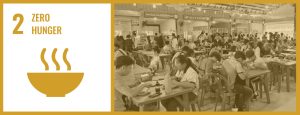
Isabela State University (ISU) promotes sustainable food choices through its Cauayan Campus food court, which provides students, faculty, and staff with access to affordable, nutritious, and vegetable-based meals. As highlighted in the feature “Good Food, Greener Roots, Fuller Plates,” campus food vendors prioritize fresh, locally sourced, and seasonal vegetables in meal preparation, offering plant-based alternatives that encourage healthier dietary choices and responsible consumption.
This practice supports local farmers, encourages the use of locally produced agricultural goods, and strengthens the connection between campus dining services and local food systems. By incorporating vegetable-rich meals into its regular food offerings, ISU promotes accessible and environmentally responsible dining while providing opportunities to expand fully vegetarian and vegan options. These efforts demonstrate the University’s commitment to sustainable food consumption, nutritional well-being, and food security in support of SDG 2 (Zero Hunger).
Healthy and affordable food choices
Isabela State University (ISU) provides healthy and affordable food choices through its Cauayan Campus food court, ensuring that students, faculty, and staff have access to nutritious meals at reasonable prices. As documented in the feature “Full Plates Without Empty Pockets,” complete meals consisting of rice, vegetables, and a main dish are available for as low as ₱55. The food court also offers vegetable-rich meal options, allowing members of the University community to make balanced food choices without placing an excessive burden on their budgets.
These affordable meal options particularly benefit students with limited daily allowances, helping them meet their nutritional needs while managing other educational expenses. Despite fluctuations in ingredient costs, campus food vendors continue to consider affordability and food quality in preparing their daily offerings. Through these efforts, ISU promotes access to nutritious and reasonably priced meals, supports the well-being of its campus community, and contributes to SDG 2 (Zero Hunger).
PROPORTION OF GRADUATES IN AGRICULTURE AND AQUACULTURE INCLUDING SUSTAINABILITY ASPECTS
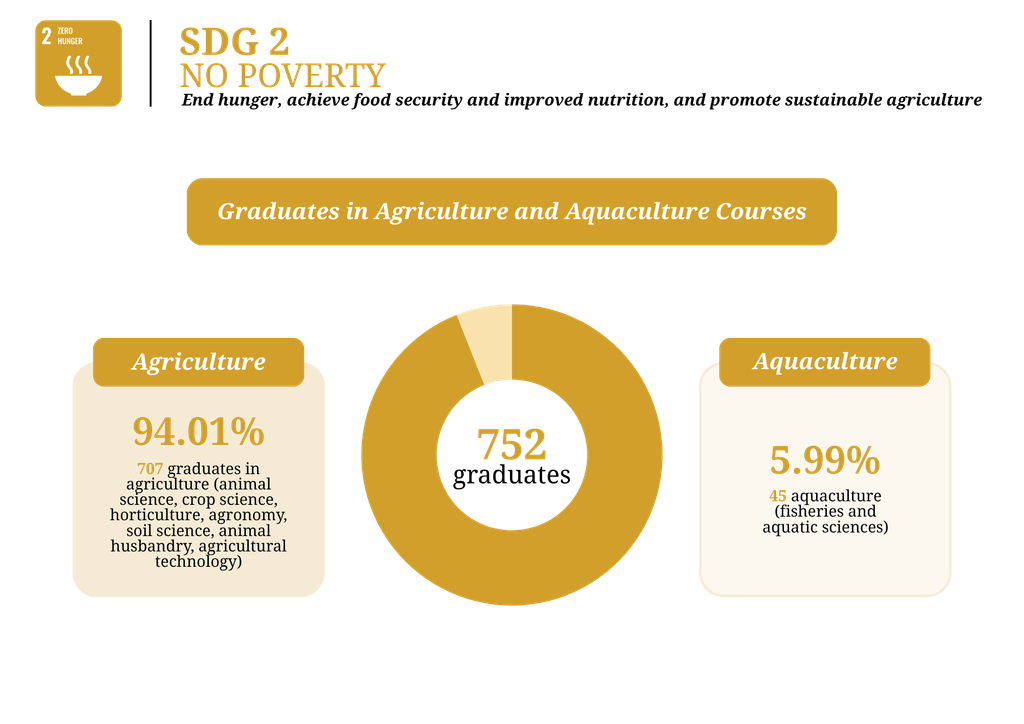
Isabela State University recorded 752 graduates from agriculture- and aquaculture-related degree programs in 2025, representing 10.54% of its 7,136 total graduates. As certified by the University Registrar, these graduates comprised 331 males and 421 females across bachelor’s, master’s, and doctoral programs offered by various ISU campuses.
Of the 752 graduates, 707 (94.01%) completed agriculture-related programs, including animal science, crop science, horticulture, agronomy, soil science, animal husbandry, and agricultural technology. Meanwhile, 45 (5.99%) graduated from aquaculture-related programs, particularly fisheries and aquatic sciences.
These disciplines are essential to sustainable food production, agricultural productivity, responsible natural resource management, and food security. The officially certified graduation records provide verifiable institutional data on the University’s contribution to developing skilled professionals in agriculture and aquaculture, strengthening sustainable food systems, and advancing SDG 2 (Zero Hunger).
NATIONAL HUNGER
Access to Food Security Knowledge
Isabela State University (ISU), through its Food Innovation Center (FIC), provides local food processors and entrepreneurs with access to technical knowledge, practical skills, and food-processing technologies through its extension program, “Technology Transfer and Capability Building Program on Sustainable and Innovative Solutions for Agricultural Resource-based Technologies.” The program promotes the sustainable utilization of agricultural resources, food security, and value-added food production through technical training and hands-on technology demonstrations. Among the activities conducted was practical training on watermelon juice pasteurization and packaging, allowing participants to gain firsthand experience in food processing and preservation. Through these initiatives, ISU strengthens the technical capabilities of local food producers, promotes agricultural innovation, and supports the development of sustainable and resilient agri-food systems.
Access to Events for Local Farmers and Food Producers
Isabela State University (ISU) facilitates knowledge exchange and networking among local livestock producers through its DOST-PCAARRD-funded Goat Food Value Chain Project. On December 17, 2025, the University conducted a project orientation for regional goat learning site owners at the Cagayan Valley Small Ruminants Research Center (CVSRRC), ISU–Echague Campus. The event brought together local producers, university researchers, agricultural specialists, industry partners, and financial institutions to exchange knowledge and explore opportunities for collaboration.
Discussions covered goat value chain development, market linkages, industry partnerships, financial assistance opportunities for micro, small, and medium enterprises (MSMEs), and the role of learning sites in strengthening livestock production. By providing a venue for knowledge sharing, stakeholder engagement, and professional networking, ISU helps local food producers connect with technical experts, potential market partners, and relevant institutions, supporting sustainable agricultural development and food security.
University access to local farmers and food producers
Isabela State University (ISU), through its Food Innovation Center (FIC) at Cauayan Campus, Isabela State University (ISU), through its Food Innovation Center (FIC) at the Cauayan Campus, provides local farmers, food producers, cooperatives, and small-scale entrepreneurs with access to food-processing facilities, technologies, and technical expertise. As highlighted in the feature “Turning Local Harvests into Products of Innovation,” the Center offers shared-use and toll-processing arrangements supported by locally designed and fabricated equipment, including vacuum fryers, cabinet dryers, food extruders, and vacuum packaging machines.
These facilities enable qualified beneficiaries to process agricultural produce into value-added products, improve product quality, extend shelf life, and potentially reduce postharvest losses. The FIC also provides technical assistance in product development, food safety, packaging, labeling, and technology adoption, helping local producers address technological and resource constraints. By opening its research facilities and innovations to agricultural communities, ISU strengthens local food production capabilities, promotes efficient resource utilization, and supports sustainable livelihood opportunities.
Through its various functions, the FIC also serves as a platform where students, researchers, farmers, and small-scale entrepreneurs can engage in food product development, food safety improvement, and process innovation. Its shared-use processing and packaging facilities provide opportunities for practical learning, experimentation, and capacity-building, strengthening the University’s academic and community engagement.
The Center’s initiatives are organized under three interrelated components:
1. Food Product Development and Value-Added Processing
The FIC contributes to ISU’s food security initiatives by transforming agricultural surplus and locally produced crops into nutritious, safe, and marketable food products. Through applied research, product development, and technology enhancement, the Center promotes the productive use of available food resources, helps minimize postharvest losses, and creates opportunities for livelihood development among farmers and small-scale processors.
2. Access to Food Processing Equipment and Facilities
The FIC provides farmers, cooperatives, and local food producers with access to food-processing equipment and shared-use facilities. These resources enable local entrepreneurs to improve product quality, extend shelf life, and enhance the marketability of their products. By making processing technologies more accessible to small producers and MSMEs, the Center helps address barriers to food processing and supports rural economic resilience and community food systems.
3. Technology Transfer and Innovation Support
The Center serves as a technology transfer platform, helping bring research outputs and innovations developed by ISU faculty and students to local communities. Through training, mentoring, and technical assistance, farmers and small enterprises gain practical knowledge in food safety, processing, and packaging. These activities help translate research and laboratory innovations into practical applications that can support local enterprise development, food security, and sustainable production.
Sustainable Food Purchases
Isabela State University (ISU) promotes sustainable institutional sourcing by strengthening linkages with local farmers, cooperatives, and agricultural enterprises and creating opportunities for locally produced goods to reach consumers and participate in university supply chains.
As documented in the ISU Cauayan Campus feature “From Farm to Institution: Making Local Producers Part of ISU’s Supply Chain,” the University provides local agricultural producers with opportunities to showcase fresh produce, planting materials, and value-added products. These engagements help establish connections between local suppliers and institutional buyers, creating potential opportunities for local products to be included in university procurement and food service operations.
Complementing these efforts, the ISU Farmers Market at the Echague Campus is a continuing initiative held every Wednesday and Friday. It provides local smallholder farmers with a venue to sell fresh, locally grown agricultural products directly to consumers. By connecting farmers with the ISU community and nearby residents, the initiative helps expand market access, create income-generating opportunities, and make affordable and nutritious agricultural products more accessible. It also reflects the University’s commitment to supporting local farmers’ livelihoods and strengthening community-based food systems.
Beyond providing a marketplace, the Farmers Market incorporates complementary activities that promote food security and community welfare. These include food drives, through which donations from ISU employees and other stakeholders are collected to support students in need, helping address student hunger and reduce potential food waste. The University also conducts skills and technology training sessions for farmers and distributes information, education, and communication (IEC) materials to strengthen their agricultural knowledge and production capabilities.
These initiatives are aligned with Republic Act No. 11321, or the Sagip Saka Act, and the national procurement framework supporting direct purchases from accredited farmers’ and fisherfolk’s enterprises. Through supplier engagement, direct marketing opportunities, capacity-building, and community support, ISU strengthens local agricultural livelihoods, promotes access to food, and contributes to more sustainable and resilient regional food systems in support of SDG 2 (Zero Hunger).