2025 Reports | SDG 9 – Industry, Innovation and Infrastructure



















Isabela State University (ISU) advances Sustainable Development Goal 9 (Industry, Innovation and Infrastructure) by promoting research-driven innovation, technology development, entrepreneurship, and collaboration with industry and government partners. Through its research commercialization initiatives and university spin-off companies, ISU transforms academic research and technological innovations into practical solutions that address industry needs, support local enterprises, and contribute to regional development.
UNIVERSITY SPIN OFFS

University spin-off companies are legally established and operational entities created to commercialize and leverage intellectual property, research outputs, and innovations generated within the institution. They serve as a mechanism for translating academic research into marketable products, technologies, and services.
Isabela State University (ISU), through Board of Regents (BOR) Resolution No. 419, Series of 2020, approved policies supporting the establishment of university spin-off companies, institutionalizing innovation-driven entrepreneurship across the University. These policies provide a framework for transforming research outputs into commercially viable ventures and strengthening the University’s contribution to industry and economic development.
In 2025, ISU had five (5) approved university spin-off companies, including the newly approved Ka-Tribu Agricultural Machinery Manufacturing, through BOR Resolution No. 75, Series of 2025. These spin-offs demonstrate the University’s continuing commitment to accelerating research commercialization, facilitating technology transfer, and fostering innovation-driven enterprises that contribute to industry development and economic growth.
Clevermatic Farming Equipment Trading
Clevermatic Farming Equipment Trading (CFET) is owned and managed by Dr. Januel P. Floresca, a faculty researcher at the College of Agriculture, Isabela State University–Echague Campus. The company was registered with the Department of Trade and Industry (DTI) on August 23, 2019, with its business address at St. James Subdivision, Venus Street, Batal, Santiago City.
CFET aims to establish itself in the field of automated farming equipment by developing, promoting, and commercializing innovative technologies, systems, and devices that address the challenges of climate change adaptation and mitigation while advancing sustainable agriculture. Its key objectives include:
- Producing, patenting, and marketing automated farming technologies, systems, and devices, such as the Intermittent Mist Propagator, which helps conserve natural resources, reduce climate change vulnerabilities, and mitigate greenhouse gas (GHG) emissions.
- Establishing demonstration farms to showcase automated farming technologies and practices that promote natural resource conservation and climate change resilience.
- Developing and promoting technologies that contribute to the reduction of GHG emissions.
Through its Intermittent Mist Propagator, CFET has served farmer-beneficiaries from the local government units of Gonzaga, Cagayan, and Maddela, Quirino, as well as a farmers’ association in Saguday, Quirino Province. These initiatives demonstrate the application of university-developed technologies in supporting farmers and promoting sustainable agricultural practices.
JNN Training Consultancy Services
JNN Training Consultancy Services provides consultancy, coaching, and training services to researchers and Micro, Small, and Medium Enterprises (MSMEs). Its services focus on business innovation, mentoring, and the delivery of standard business support services. The spin-off was established by Dr. Jonathan N. Nayga, a professor at the College of Agriculture, Isabela State University–Echague Campus.
Its potential clients include MSMEs, entrepreneurs, cooperatives, established companies, government agencies such as the Department of Science and Technology (DOST), Department of Trade and Industry (DTI), Department of Labor and Employment (DOLE), Cooperative Development Authority (CDA), and Department of Agriculture (DA), as well as state universities and colleges (SUCs), local government units (LGUs), and start-up businesses.
Through its consultancy and mentoring services, JNN aims to strengthen the innovation and business development capabilities of enterprises and researchers. The company addresses the need for specialized business support services in the region, helping prospective and existing enterprises improve their operations and pursue sustainable growth.
Drolly’s Holistic Therapy and Training Center
Drolly’s Holistic Therapy and Training Center is a university spin-off owned and managed by Dr. Drolly P. Claravall, a faculty member of Isabela State University–Ilagan Campus. The center provides therapeutic and wellness services to individuals experiencing various conditions associated with bodily pain, promoting proper care, rehabilitation, and overall well-being.
A key innovation of the center is an ergonomically designed handheld massage tool developed by Dr. Claravall, who pioneered its application in what is known as “blading therapy.” Through this innovation, she received the recognition Makabago at Natatanging Produktong Pang-Isports during the 2021 Gintong Gawad, a national search recognizing outstanding and inspiring contributions to women in grassroots communities.
The center subsequently became an accredited Technical Education and Skills Development Authority (TESDA) Training Center for Basic Care Services NC II, focusing on the management of chronic and acute bodily pain using the handheld massage tool. Through this program, 48 Barangay Health Workers have received training, extending the benefits of the innovation to community-based health services.
In recognition of her innovation and contributions, Dr. Claravall received the Civil Service Commission Pag-asa Award in 2023. The center demonstrates how university-based innovation can be developed into practical health and wellness services, while also supporting skills development among community health workers.
Synqbox Software Development Services
Synqbox Software Development Services, commonly known as Synqbox, is a university spin-off originating from research conducted by Dr. Betchie Aguinaldo of the College of Computing Studies, Information and Communication Technology (CCSICT), Isabela State University–Cauayan City Campus. It was approved by the ISU Board of Regents through BOR Resolution No. 122, Series of 2023, and formally established on January 25, 2024, through a Memorandum of Understanding among DOST Region II, Isabela State University, and Synqbox.
Synqbox demonstrates how university research can be transformed into technology-based solutions that address community and industry needs. It is among the start-ups supported by the DOST-ISU Smart City Technology Business Incubator (DISC-TBI), which helps develop local technology entrepreneurs and strengthen the regional start-up ecosystem.
Funded by the DOST-Philippine Council for Industry, Energy and Emerging Technology Research and Development (DOST-PCIEERD) through its Higher Education Institution Readiness for Innovation and Technopreneurship (HEIRIT) program, DISC-TBI provided support to Synqbox in developing the knowledge and processes needed to transform research outputs into commercially viable products. This assistance guided the technology through the pre-commercialization stage and toward the establishment of the spin-off company.
One of Synqbox’s flagship innovations is the Digital Business Locator (DBL), a digital investor’s scorecard for Business Process Outsourcing (BPO) companies. Funded by DOST Region II through the Business Intelligence Research and Development Center (BIRD-C), the technology has been commercialized and adopted by the Cauayan City Government to map business locations, utilities, transportation networks, and workforce data. Its application contributed to the city’s investment promotion efforts, including the establishment of Everise Philippines, the region’s first BPO company, in Cauayan City on March 8, 2025. The establishment generated more than 845 local jobs, demonstrating the potential of research-based digital solutions to support investment attraction and employment generation.
Another major innovation developed by Synqbox is the Optimization of Decision Support System for Effective E-Governance (ODeSSEE), funded by DOST-PCIEERD. This data-driven decision support system assists local governments in disaster and health emergency management by identifying safe, unsafe, and alternative evacuation sites during flooding and public health emergencies, including COVID-19. The technology contributed to Cauayan City’s recognition as second place in the Best in LGU Empowerment category of the 2021 Digital Governance Awards.
Ka-Tribu Agricultural Machinery Manufacturing
Ka-Tribu Agricultural Machinery Manufacturing, developed by Dr. Joel M. Alcaraz, Professor VI at the College of Engineering, is a university spin-off that specializes in the development and manufacture of agricultural machinery and food-processing equipment to support local industries, particularly Micro, Small, and Medium Enterprises (MSMEs) in the agri-aqua sector. Approved as an ISU spin-off firm in 2025 through the University’s Intellectual Property and Technology Business Management (IPTBM) initiatives under the Regional Agri-Aqua Innovation System Enhancement in Cagayan Valley Program, the company exemplifies ISU’s efforts to transform engineering research and innovations into practical, marketable technologies.
The company focuses on developing locally manufactured equipment designed to improve food-processing operations, reduce production costs, and maintain product quality. Its machinery innovations include:
- Multi-crop washer with ozonizer
- Flour sieving machine
- Multi-crop pulverizing machine
- Vegetable and food dryer
- Mechanical evaporator/stirrer/mixer
- Hopia molding machine with reversible burner
- Powder and liquid mixing machine
- Size sorting machine
- Briquetting machine
These machines are developed using food-grade materials and undergo research and development and product design processes to meet industry requirements. The company has also secured various certifications, registrations, and clearances to support compliance with applicable national standards.
To advance technology transfer and commercialization, ISU-IPTBM, in collaboration with the DOST-PCAARRD-ISU Agri-Aqua Technology Business Incubator (ISU-ATBI), facilitates the promotion and adoption of Ka-Tribu’s technologies among MSMEs across the region. Through these initiatives, ISU supports the development of locally manufactured technologies, strengthens MSME capabilities, and promotes innovation within the regional agri-aqua industry.
RESEARCH INCOME FROM INDUSTRY AND COMMERCE
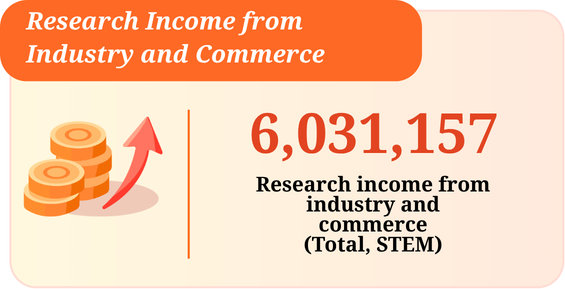
Isabela State University generated a total research income of ₱6,031,157 from industry and commerce, with the entire amount attributed to research projects in the Science, Technology, Engineering, and Mathematics (STEM) fields. This funding came from two major institutional partnerships: ₱4,449,600 from the Japan International Cooperation Agency (JICA) and ₱1,581,557 from the University of the Philippines Los Baños Foundation, Inc. (UPLBFI).
The JICA-funded research engagement supports hydrological and bathymetric surveys, including suspended solid monitoring and riverbed material sampling in the Magat Watershed and Cagayan River Basin, as well as a bathymetric survey of the Magat Dam Reservoir. Meanwhile, the UPLBFI-supported project, Modelling Climate Information Services (CIS) Application in the Agricultural Sector through Tripartite Collaborations (SUC-NGA-LGU) in Region II, Northern Philippines, contributes to the application of climate information in agricultural research and decision-making.
These research partnerships demonstrate ISU’s capacity to secure external research funding and collaborate with national and international institutions in addressing critical challenges in water resource management, climate resilience, and sustainable agriculture. They also highlight the University’s role in advancing applied research and translating scientific knowledge into solutions that support regional development.